
In order to accelerate the deployment of renewable energy and the efficient use of network capacity, the state has established a separate fee for unused generation capacity in the Electricity Market Act. The law provides a period for commencing generation, which is one year for solar panels and two years for other technologies from the date the network operator notifies the customer that the network connection with the agreed generation conditions has been completed. In electricity generation, it is required to supply at least 95% of the contractual network capacity to the network.
According to the Electricity Market Act, as specified in 2026, the fee for unused generation capacity only applies to the use of generating installations which have a capacity of more than 15 kW. Micro-producers with generating installations of up to 15 kW are not required to pay the fee.
Why is the fee applied?
The fee helps to ensure that network resources are not left unused for long periods of time and that only those who actually produce electricity can start or continue production.
If the amount of electricity supplied to the network remains below 95% of the production capacity agreed in the contract, the user of the network connection is required to pay for the unused generation capacity in accordance with the law. The fee is the difference between 95% of the contractual network capacity and the actual capacity used, ie the maximum capacity supplied to the network.
When is the fee applied?
The fee is charged on a calendar-year basis. In the first half of 2026, the two-year monitoring period prescribed by law ended for electricity producers whose connection conditions for electricity generation had been completed before March 2023. For these electricity producers, the fee for unused generation capacity will henceforth be calculated on a calendar-year basis, meaning that the fee for 2026 will be calculated at the beginning of 2027.
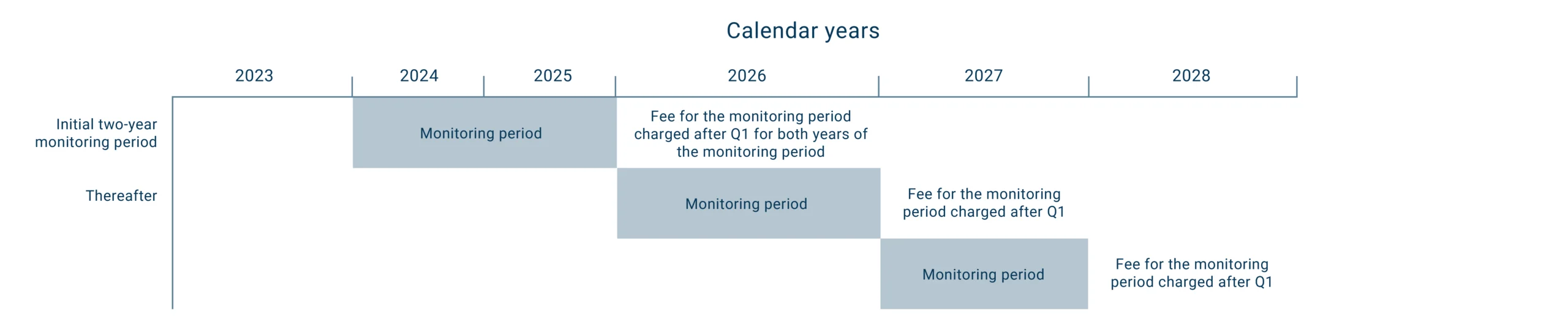
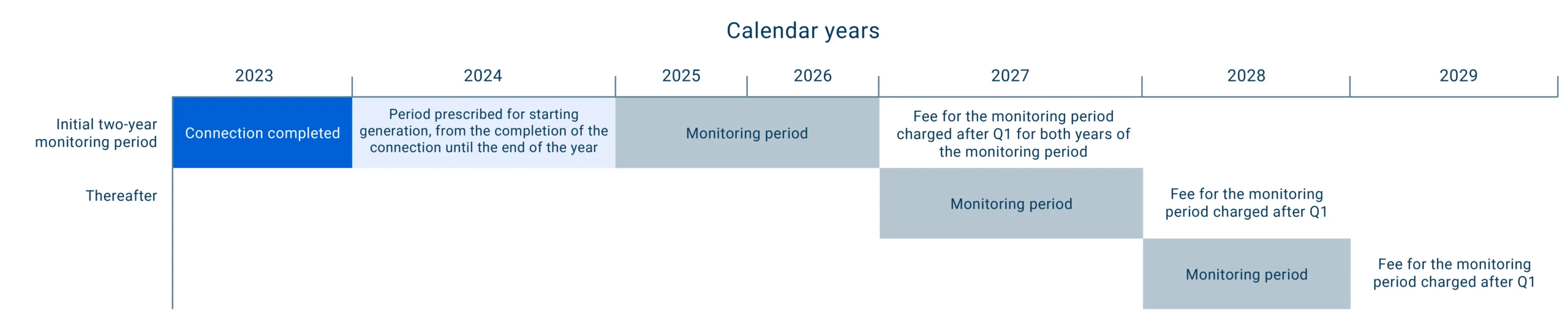
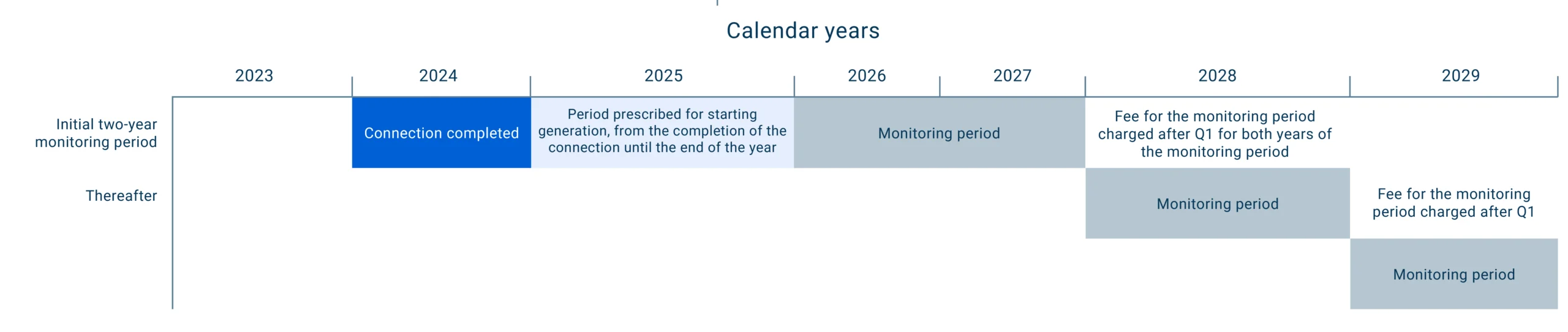
For the remaining consumption points with electricity generation connection conditions completed in 2023, the initial two-year monitoring period covers the calendar years 2025 and 2026. These are the years used to determine the maximum capacity supplied to the network and for which the fee will be charged in 2027 after the end of the first quarter. After the initial two-year monitoring period, the maximum generation capacity will be monitored and the fee charged for each subsequent calendar year.
The fee for unused generation capacity is charged once per year as an annual fee. The amount of the fee is determined by the Electricity Market Act at €38 per year for each kilowatt of unused generation capacity, ie capacity not supplied to the network (plus VAT). After the initial two-year monitoring period, the fee is charged for both years at the same time. In the future, the fee will be charged regularly once a year following the conclusion of each calendar year.
See examples of how the fee for unused generation capacity is calculated when solar generation is commissioned. For solar energy, one year is allowed for commencing generation, while two years are allowed for other technologies.
Electricity generation permitted before 18 March 2023
Electricity generation permitted from 18 March 2023
Electricity generation permitted in 2024
Please note that if the production conditions stipulated in the connection contract have not been implemented within three years from the completion of the connection, the network operator will no longer guarantee the possibility of using the network connection under those conditions after the three-year period has elapsed, and no fee for unused production capacity will be charged.
How is the generation capacity supplied to the network calculated?
The capacity supplied to the network is based on the quantities measured by the network operator’s meter during the measurement period, from which the average capacity for the period is calculated. The metering period is one hour (60 minutes) until March 2025 and 15 minutes from April 2025 onwards.
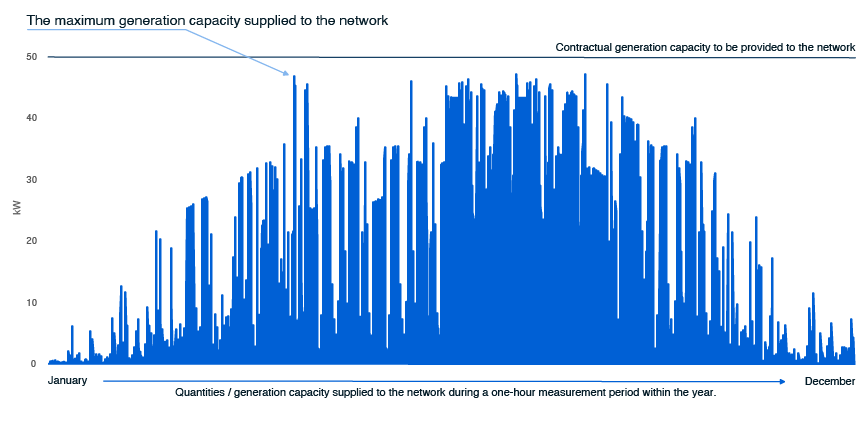
The maximum capacity supplied to the network is the highest value recorded during a single measurement period within the monitoring period (one or two calendar years). The electricity generation requirement is met if, during one measurement period within the monitoring period, at least 95% of the network capacity has been supplied to the network.
The quantities supplied to the network can be viewed on the Elering Data Exchange Platform.
Log in to the Elering customer portal and select ‘My Production’.
- To view data, select the point of consumption, period and interval (15 minutes, hour, month, etc).
- For the year 2024, view the hourly data.
- To view the quantities supplied to the network in 2025, we recommend selecting the period 2025 and the interval 15 minutes.
- Find the maximum value for the selected period. Multiply this value by four to obtain the average capacity supplied to the network per 15 minutes.
- Compare the result with the capacity agreed in the network contract.
- Check whether this result covers the capacity agreed in the contract.
How to optimise network capacity and avoid the fee?
To optimise, we ask you to analyse the use of electricity generation equipment together with electricity consumption at the point of consumption. If the generating installations have been installed with a lower capacity than the agreed capacity to be supplied to the network and you do not plan to use the full capacity in the future, we recommend reducing the network capacity. The released network capacity makes it easier for other electricity producers to connect to the network.
The generation capacity agreed in the contract for supply to the network can be reduced at any time and this is free of charge.
An application must be submitted for a reduction to the e-mail address [email protected]. After the generation capacity has been reduced, the previous generation capacity may no longer be used. Any subsequent increase in the generation capacity supplied to the network must be made in accordance with the connection conditions.
An application to reduce the agreed capacity can be submitted at any time. To ensure that the reduced capacity can be taken into account when preparing the invoice, the application must be submitted by 15 March at the latest. In such cases, the reduced capacity will be taken into account when calculating the fee for the monitoring periods of previous calendar years.
For example:
- If a producer has a contractual generation capacity of 50 kW for supply to the network and actual usage in 2026 was 35 kW, the fee is calculated based on the unused generation capacity using the formula 50 x 0.95 – 35 kW.
- If the producer reduces its contractual generation capacity to 40 kW, the fee in April will already be calculated based on the reduced capacity, using the formula 40 x 0.95 – 35 kW.
Frequently Asked Questions
When and to whom does the unused production capacity fee apply?
Under the law, the unused production capacity fee applies only to the use of generating installations with a capacity exceeding 15 kW. Micro-producers with generating installations with a capacity of up to 15 kW are not required to pay the fee.
When calculating the fee, the production capacity of the generating installation specified in the contract is first considered, ie the production capacity of the generating installation whose use has been agreed.
Next, the capacity supplied into the network is compared with the contractually agreed capacity to be supplied to the network (in the contract: the network connection capacity for supplying electricity into the electricity network). If the actual capacity supplied to the network falls below 95% of the contractually agreed capacity to be supplied to the network, the fee is applied on the basis of the difference between the two.
Example:
- at the connection point, a generating installation with a capacity of 50 kW is in use.
- the contractually agreed capacity to be supplied to the network is 12 kW,
- the capacity actually supplied to the network during the period was 9 kW.
For such a generating installation, the unused production capacity fee is applied, as a generating installation with a capacity exceeding 15 kW is in use.
- The contractually agreed capacity to be supplied to the network is 12 kW, of which the 95% electricity production requirement is 11.4 kW.
- The actual capacity supplied to the network was 9 kW, which is lower than 95% of the contractually agreed capacity to be supplied to the network.
- Therefore, the fee is calculated on the basis of 11.4 kW – 9 kW = 2 kW.
How is the fee applied to the holder of a generation-oriented network contract?
The fee for unused generation capacity is calculated based on the use of the generating installation connected to the network during each monitoring period. The periods are calculated in full calendar years. If the start of the monitoring period falls in the middle of a calendar year, the monitoring period will begin from the following calendar year.
The monitoring period begins after the deadline for starting electricity generation has passed. The initial monitoring period is two years, after which the annual fee is charged for both years simultaneously. The duration of the subsequent monitoring periods is one year, after which an annual fee is charged.
How is the capacity used as the basis for the fee calculated?
The fee is calculated as the difference between 95% of the contracted capacity to be supplied to the network (kW) and the maximum capacity supplied to the network (kW) during the period, rounded down to the nearest kilowatt.
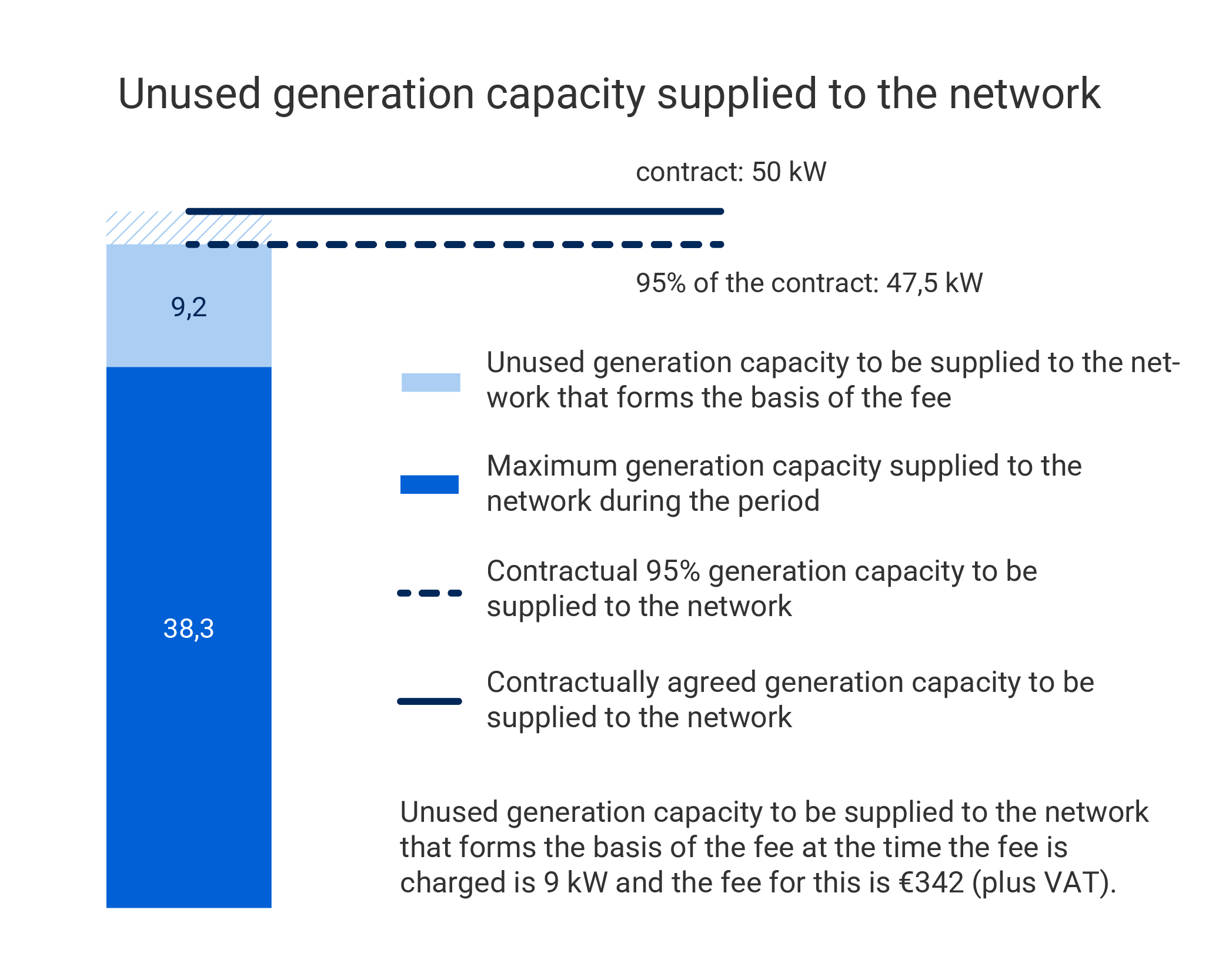
Example: the contracted capacity supplied to the network is 50 kW, of which the 95% production requirement amounts to 47.5 kW. The maximum capacity measured during the period is 38.3 kW. The difference between the 95% production requirement and the actual capacity corresponds to the unused capacity on which the fee is based: 47.5 kW – 38.3 kW = 9.2 kW, which is rounded down and the fee is charged for 9 kW.
How is the power supplied to the network during the measurement period calculated?
The meter at the point of consumption measures the amount of electricity supplied to the network in kilowatt-hours (kWh). When measuring the amount supplied to the network, the time length, that is, the measurement period, is either 60 minutes or 15 minutes. The total amount of kilowatt-hours supplied to the network during the measurement period is measured.
The calculation of power is based on the amount of electricity supplied to the network during the measurement period and the average power calculated from it.
If the measurement period is 15 minutes, the average power for the period is calculated by dividing the amount of electricity supplied to the network during that period in kilowatt-hours by a quarter of an hour (ie by 0.25).
Example: if 12 kWh of electricity was supplied to the network over a 15-minute period, then dividing this by a quarter of an hour (ie by 0.25) results in 48 kW, meaning that the average power supplied to the network during that 15-minute period is 48 kW (the same result is obtained if the amount of electricity supplied to the network during the 15-minute measurement period is multiplied by four).
If the measurement period is one hour, that is, 60 minutes, then the measured amount in kilowatt-hours is equal to the average power for the period.
Example: if 43 kWh was supplied to the network in one hour, then the average power for that hour is 43 kW (43 kilowatt-hours (kWh) divided by 1 hour (h) equals 43 kilowatts (kW)).
What if the meter does not measure a 15-minute measurement period?
In such a case, the amount of electricity measured in kilowatt-hours over 60 minutes is divided equally into four 15-minute intervals. The power supplied to the network is calculated based on the resulting 15-minute amount.
When is the 95% electricity generation requirement considered fulfilled?
The electricity generation requirement is fulfilled if, at least once a year, the average power supplied to the network during a single 15-minute measurement period reaches at least 95% of the contractually agreed generation capacity for supplying electricity to the network (ie the network capacity for supplying electricity to the network).
Imatra Elekter has established the principle that, when applying the fee, unused generation capacity and the fee are to be calculated in kilowatt precision, rounded down. If the unused generation capacity is less than one kilowatt, no fee is charged in such a case.
Example: If the power to be supplied to the network is agreed as 36 kW in the network contract, then based on the 95% requirement, at least 36 kW × 0.95 = 34,2 kW must be supplied to the network during one 15-minute measurement period.
However, if the actual maximum capacity supplied to the network was 33.612 kW, the fee for unused generation capacity is calculated as (36 × 0.95) – 33.612 = 0.588 kW, and rounding down to the nearest kilowatt, the unused portion on which the fee is based amounts to 0 kW.
Do I have to pay the unused generation capacity fee if, during the initial two-year monitoring period, I met the generation requirement in one year but did not meet it in the other?
In that case, the unused generation capacity fee does not have to be paid. During the initial two-year monitoring period, the maximum generation capacity supplied to the grid over the entire two-year period is taken into account.
When does a new connected party start paying the fee for unused generation capacity?
The generation conditions must be implemented within one year for solar panels and within two years for other technologies after the fulfilment of the connection contract by the network operator. We will send the party to the connection contract a notification confirming the fulfilment of the connection contract.
Please note that if the generation conditions stipulated in the connection contract have not been implemented within three years of the completion of the connection, Elektrilevi will no longer guarantee the possibility of using the network connection under those conditions after the three-year period has elapsed.
Under the terms of the connection contract of Imatra Elekter, the generation conditions agreed in the connection contract must be commissioned within three years of the completion of the connection. If the relevant conditions have not been commissioned under the network contract within this period, the network operator will not guarantee the right to use the network connection under those conditions and no fee for the unused production capacity will be charged.
Who pays the fee if the network contract holder changes?
The fee is charged based on the point of consumption and is issued to the holder of the valid network contract at the time the invoice is issued.
How is the fee applied if the generation condition has not been implemented under a network contract?
- The fee for unused generation capacity is based on the generation capacity to be supplied to the network, as agreed in the connection contract.
- If, after the fulfilment of the connection contract, no network contract has been concluded for the point of consumption for the use of network services (ie there is neither a network contract under consumption conditions nor under generation conditions), the fee will be charged to the connection party.
- If the registered immovable has been transferred or the connection party’s authorisation to use the registered immovable has expired, the fee for unused generation capacity will be applied to the owner of the registered immovable at the time the fee is issued.
- If a network contract under consumption conditions has been concluded for the network connection, and no agreement on generation conditions has been included in the contract, the fee is charged to the person who is the party to the consumption-conditions-based network contract at the time the fee is issued.
- Please note that if the production conditions stipulated in the connection contract have not been implemented within three years from the completion of the connection, the network operator will not guarantee the right to use the network connection under those conditions after the three-year period, and no fee for unused production capacity will be charged.
Who pays the fee if there is no valid network contract?
- If no network contract has been concluded after the completion of the connection, the fee is charged to the party who signed the connection contract. If the property has been sold, the fee must be paid by the new owner of the property.
- If there is no network contract, the owner of the registered immovable must pay the fee.
- If a valid network contract is terminated, the owner of the property must pay the fee.
Are micro-producers required to pay the fee?
Micro-producers with a generating installation of up to 15 kW are not required to pay the fee.
According to the Electricity Market Act, as specified in 2026, the fee for unused generation capacity only applies to the use of generating installations which have a capacity of more than 15 kW.