
An electricity meter measures how much electricity is consumed from the network at the place of consumption and how much electricity is supplied to the network. Data is measured at intervals of either one hour or 15 minutes, depending on the meter and the method used for storing metering data.
How is metering data calculated?
The electricity meter measures electricity volumes separately for each phase and quantities flowing in the same direction are added together.
For example: 5 kWh of electricity is consumed on one phase, 2 kWh on another phase and 3 kWh of generated electricity is supplied to the network on the third phase. For that period, the meter records:
- 7 kWh consumed from the network,
- 3 kWh supplied to the network.
Net metering data
From 1 August 2026, in accordance with the Electricity Market Act, electricity invoices for places of consumption equipped with a bidirectional meter will be based on net metering data.
Net metering data show the difference between the amount of active energy (kWh) taken from the network and the amount supplied to the network during each 15-minute metering interval. These data are used to prepare network and electricity invoices.
Net metering data is calculated where the meter measures electrical energy in two directions: consumption from the network and supply to the network. In such cases, the difference between the amount of electricity consumed and the amount supplied to the network is calculated for each metering period.
The introduction of net metering data does not change how the meter measures electricity. If your place of consumption is equipped with a bidirectional meter, net metering data will be calculated automatically and you do not need to take any action. This is a standard calculation method that is applied automatically and uniformly to all customers with the relevant type of meter.
In addition to the data measured by the meter, we also provide sellers of electricity with net metering data via the data exchange platform.
How is net metering data calculated?
Net metering data is calculated for each 15-minute metering period.
If more electricity is consumed from the network than supplied to the network during a metering period, net consumption occurs.
Example of net consumption:
- 7 kWh was consumed from the network during the metering period;
- 3 kWh was supplied to the network;
- subtracting these amounts (7 kWh – 3 kWh) results in net consumption of 4 kWh;
- the amount of net supply to the network is 0 kWh.
If more electricity is supplied to the network than consumed from the network during a metering period, net supply to the network occurs.
Example of net supply to the network:
- 2 kWh was consumed from the network during the metering period;
- 8 kWh was supplied to the network;
- subtracting these amounts (8 kWh – 2 kWh) results in net supply to the network of 6 kWh;
- the amount of net consumption is 0 kWh.
If consumption and supply to the network are equal during the same metering period, both net consumption and net supply to the network are 0 kWh.
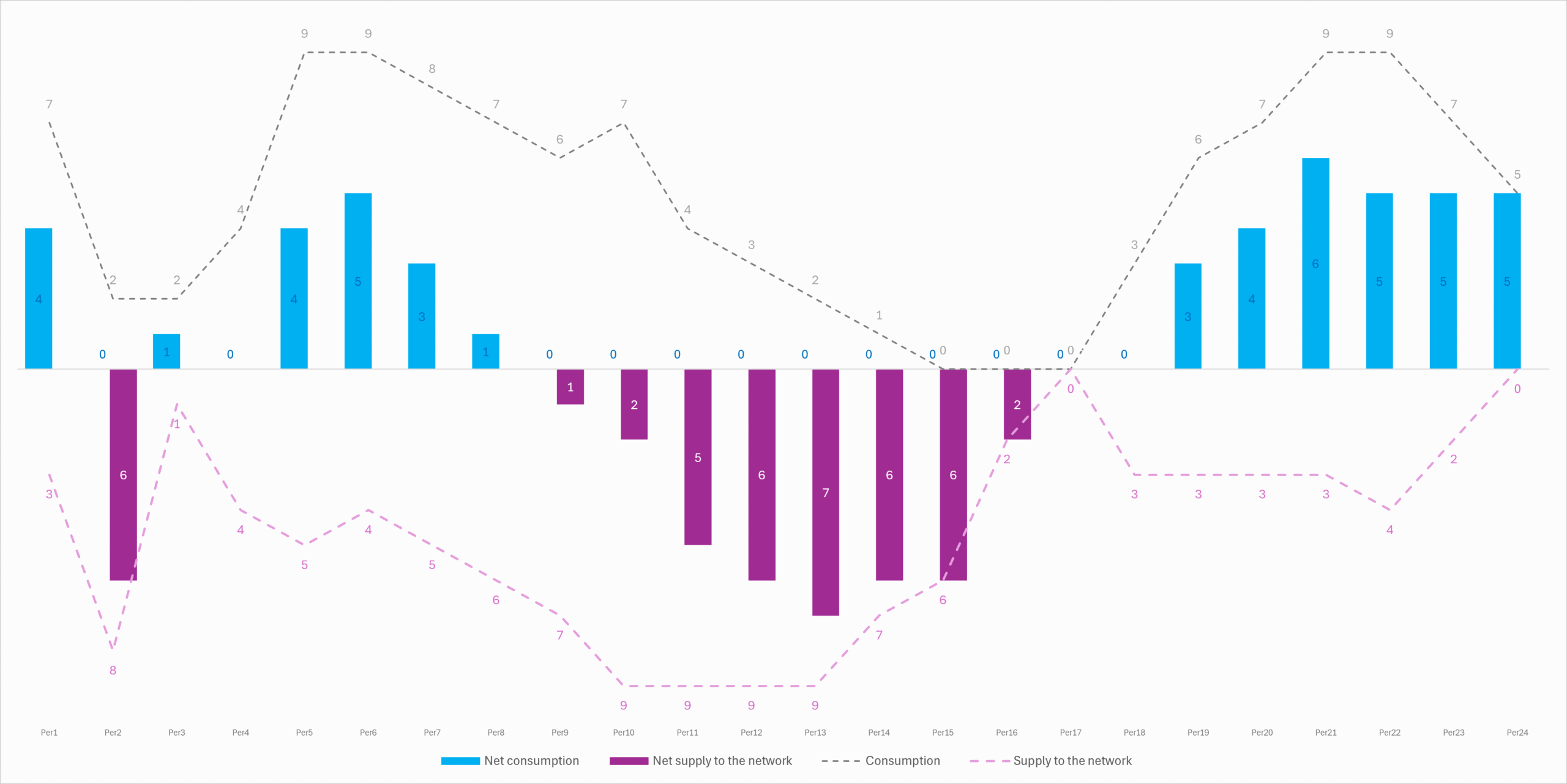
| Period (15 min) | Consumption | Supply to the network | Net consumption | Net supply to the network |
| Period 1 | 7 | 3 | 4 | 0 |
| Period 2 | 2 | 8 | 0 | 6 |
| Period 3 | 2 | 1 | 1 | 0 |
| Period 4 | 4 | 4 | 0 | 0 |
| Period 5-n | 9 | 5 | 4 | 0 |
| Total for all periods | 24 | 21 | 9 | 6 |
Net metering data are calculated separately for each 15-minute metering interval. During each metering interval, the amount of electricity taken from the network is compared with the amount supplied to the network, and the difference is calculated. The net electricity taken from the network and the net electricity supplied to the network are then totalled separately for all metering intervals. As a result, the total net electricity taken from the network or the total net electricity supplied to the network for the period may not equal the simple difference between the total electricity taken from and supplied to the network. For example, in the period shown in the table, electricity consumption was 24 kWh and 21 kWh was supplied to the network, resulting in net electricity taken from the network of 9 kWh and net electricity supplied to the network of 6 kWh.
Example of how net metering data are reflected in billing
| Until 31 July 2026 | From 1 August 2026 |
| Electricity taken from the network: 24 kWh | Electricity taken from the network: 24 kWh |
| Electricity supplied to the network: 21 kWh | Electricity supplied to the network: 21 kWh |
| Electricity consumption used for billing: 24 kWh
Electricity supplied to the network: 21 kWh |
Net electricity consumption used for billing: 9 kWh
Electricity supplied to the network: 6 kWh |
How does net metering data affect billing?
From 1 August 2026, network operators and sellers of electricity will use net metering data as the basis for preparing invoices.
The amount of net electricity taken from the network is used to calculate active energy (kWh)-based network charges:
- network transmission charge,
- renewable energy charge,
- security of supply charge,
- excise duty on electricity.
Frequently Asked Questions
- For which quantities is net metering data calculated?
Net metering data is calculated when the meter separately measures active energy consumption and supply to the network, ie when the meter is bidirectional. Net metering data is calculated only for active energy (kWh); net quantities are not calculated for reactive energy.
- Do I need to do anything to enable net metering data?
No. If your place of consumption is equipped with a bidirectional meter, net metering data will be calculated automatically and uniformly for all customers with the relevant type of meter.
- How does the quantity used for billing change?
With the introduction of net metering data, the data used as the basis for billing will change. Previously, the amounts of electricity taken from and supplied to the network were accounted for separately. From now on, billing will be based on the net quantity for each metering interval.
Example: During a 15-minute metering interval, the meter recorded 3 kWh of electricity taken from the network and 1 kWh of electricity supplied to the network.
| Before net metering | With net metering |
| The following quantities were used for billing: • Electricity taken from the network: 3 kWh • Electricity supplied to the network: 1 kWh (billed as a separate energy quantity). |
The following quantities are used for billing: • Net electricity consumption: 2 kWh (3 kWh − 1 kWh) • Net electricity supplied to the network: 0 kWh |
From 1 August 2026, net metering data will be transmitted to electricity suppliers via Elering’s data exchange platform (Estfeed), and suppliers will use these data for billing in accordance with the terms of their contracts.
- Which network charge components are not affected by net metering?
Net metering does not affect the calculation of the following network charge components:
-network connection capacity charge (kW),
-reactive energy charge (kvarh),
-other capacity-related charges (eg excess capacity charges) or contract-based charges.
- Do net quantities affect the calculation of usage capacity and monitoring of the use of a network connection?
No. The calculation of usage capacity and monitoring of the use of a network connection continue to be based on the quantities measured by the meter.
- Which metering data is sent to the national data exchange platform?
For each 15-minute metering period, consumption and supply-to-the-network metering data are sent to the national data exchange platform as before. From 1 August 2026, net consumption and net supply-to-the-network data will also be sent in addition.
- How is net metering data rectified?
Net metering data is rectified when the metering data for consumption or supply to the network changes. First, the consumption and supply-to-the-network data are rectified, and new net metering data is then calculated based on these values.
- I am not an electricity producer. Why was a bidirectional meter installed for me?
Bidirectional meters are not installed only for electricity producers. The type of meter installed depends on the technical solution at the place of consumption and the communication technology used (eg PLC or P2P). Newer meters are generally bidirectional and are also used at places of consumption where electricity is not fed into the network. Using a standardised solution is more cost-effective and helps avoid replacing the meter should the customer wish to start generating electricity in the future.
- I am not an electricity producer. Will a bidirectional meter affect my invoice?
A bidirectional meter does not increase your invoice. If you do not feed electricity into the network, your metered consumption and net consumption will be the same, and your invoice will be based on the amount of electricity consumed from the network.
However, you may still see the term ‘net consumption’ on your invoice, as the amount of net consumption is used when calculating network charges based on active energy consumption. If you do not feed electricity into the network, this does not affect the amount of electricity billed.
If you receive a joint invoice, the separately metered amount for the network service may not be shown. In this case, the net consumption amount is displayed on the invoice line.
- How do net metering and netting work?
With net metering, electricity consumed from and fed into the network is measured separately. With netting, net consumption and net generation are compared.
To determine the netted amount, net generation is deducted from net consumption. This amount is used to calculate charges for which legislation or pricing principles require the use of the netted amount.
Electricity excise duty is calculated based on the net amount of electricity consumed. The renewable energy charge and the security of supply charge are calculated based on the netted amount.